Saturday, September 20, 2014

Teslin Lake update, September 20 2014


The colors changed quickly, in less than a week, from all green to just about all yellow!

The good bird movement continued from the early September period into this mid-September period but just for a few days. The period started with unsettled weather (meaning more rain) but quickly turned into unseasonally nice and warm weather and after the 13th pretty much all the migration came to a sudden halt. Towards the end the weather got lousy again (meaning even more rain!) but the bird movement didn't pick up at all, quite the opposite in fact. In the last five days we had four days with less than 10 birds banded!

This young Tennessee Warbler was a real surprise at the late date of Sept 16. Below two very different looking young male Sharp-shinned Hawks - the one on the left has the usual look whereas the finely striped one on the right has a pattern more associated with young Cooper's Hawk.


The banding total for the period was 234 birds with the following top five: Slate-colored Junco (51), Orange-crowned Warbler (24), Ruby-crowned Kinglet (22), Pine Siskin (22) and Yellow Warbler (20). Three new species for the season were caught: Gray Jay on the 14th, and Downy Woodpecker and Tennessee Warbler both on the 16th. The Tennessee is a very late record for the Yukon although not the latest ever. Even though they didn't make it to the top five, American Tree Sparrows entered the scene strongly early in the period and then, just like all the other birds, just disappeared. The current top five for the season is Alder Flycatcher (506), Yellow Warbler (504), Pine Siskin (297), Yellow-rumped Warbler (172) and Wilson's Warbler (163). The number of Yellow Warblers is a new season record.

Tail feather shape and pattern comparison between juvenile (L) and adult (R) Black-capped Chickadee

For some reason this young Northern Waterthrush hasn't molted (i.e. replaced) its greater coverts. This is a prime example showing how poor quality the juvenile feathers are to be this worn already at mid-September, and why the young birds need to replace those feathers before heading south.

A juvenile male Northern Harrier
There was some decent raptor movement early in the period including 137 on the 11th (American Kestrel 54, Northern Harrier 42, Merlin 8, Peregrine Falcon 4), 135 on the 12th (Sharp-shinned Hawk 60, American Kestrel 21, Peregrine Falcon 5), and 98 on the 13th (Sharp-shinned Hawk 56, American Kestrel 14, Peregrine Falcon 3). On the 12th four somewhat late Swainson's Hawks were seen as well as the season's first Rough-legged Hawk. This is the first time all three Buteo species have been seen on the same day at the observatory (incl. Red-tailed Hawk)! The same early days had decent morning movements of songbirds, primarily American Robins, Varied Thrush and Yellow-rumped Warblers but the numbers didn't climb over a couple of hundred per species until the cold morning of the 17th when over 600 thrushes (330 Robins, 70 Varied Thrush and 250ish unidentified) were counted.

This adult Horned Grebe molting into its winter-plumage has been sailing back and forth off the point for several days now.

A fly-by Common Merganser
 Other sightings of interest included a juvenile Sanderling from the 12th through the 14th, four early Mountain Bluebirds on the 14th as well as the season first Barrow's Goldeneyes, late juvenile Spotted Sandpipers and likewise a late male Purple Finch on the 16th, our earliest ever Yellow-billed Loon, a full breeding-plumaged adult, and our latest ever Olive-sided Flycatcher on the 18th, and finally the season's first Northern Hawk Owl on the 19th.

A juvenile Sanderling on the 12th

One of the flock of four Barrow's Goldeneyes on the 14th
"How many clowns fit in a VW beetle?" How about squirrels in one cavity...?

Here are the banding totals as of Sept 20 including birds banded as part of the owling effort (the number in brackets is the number banded since the last blog entry):

Sharp-shinned Hawk - 14 (6)
Solitary Sandpiper - 1
Wilson's Snipe - 1
Boreal Owl - 21 (5)
Belted Kingfisher - 9 (1)
Downy Woodpecker - 1 (1)
Western Wood-Pewee - 4 (2)
Yellow-bellied Flycatcher - 3
Alder Flycatcher - 506 (12)
Least Flycatcher - 2
Hammond's Flycatcher - 8 (1)
Dusky Flycatcher - 4 (1)
Warbling Vireo - 12
Gray Jay - 1 (1)
Black-capped Chickadee - 15 (2)
Boreal Chickadee - 3
Red-breasted Nuthatch - 3
Ruby-crowned Kinglet - 67 (22)
Gray-cheeked Thrush - 10
Swainson's Thrush - 49
American Robin - 9
Varied Thrush - 3
Tennessee Warbler - 1 (1)
Orange-crowned Warbler - 149 (24)
Yellow Warbler - 504 (20)
Yellow-rumped Warbler - 172 (16)
Townsend's Warbler - 10
Blackpoll Warbler - 61 (1)
American Redstart - 25
Northern Waterthrush - 48
Common Yellowthroat - 79 (8)
Wilson's Warbler - 163 (11)
American Tree Sparrow - 16 (14)
Chipping Sparrow - 15
Savannah Sparrow - 17
Fox Sparrow - 16 (3)
Lincoln's Sparrow - 8 (1)
White-crowned Sparrow - 15 (3)
Golden-crowned Sparrow - 1
Slate-coloured Junco - 130 (51)
Rusty Blackbird - 9 (5)
Brown-headed Cowbird - 2
Purple Finch - 3
White-winged Crossbill - 2
Common Redpoll - 1
Pine Siskin - 297 (22)

Total = 2490 (234) birds of 46 species

Wednesday, September 10, 2014

Teslin Lake update, September 10 2014

Moonset on a cold morning, Sept 9. Notice the fresh snow on the mountain.

The first ten days of September were very variable with weather including two and a half days of solid rain (the 5th-7th) which brought the lake water up by more than 10cm and on the 8th the first subzero temperatures as we opened that morning at -3˚C! Higher up the rain came as snow so now the surrounding mountains have beautiful white caps. The last three days also offered some nice and much welcomed sunshine.

Ted Murphy-Kelly enjoying the rare warmth of sun
This Alder Flycatcher received band number 2730-88888!

 When it wasn't raining and we were able to operate the birds were on the move. During the period we had three over 100 bird days (106 on the 2nd, 141 on the 8th, and 105 on the 9th) and banded a total of 686 birds. The top five for the period was Yellow Warbler (187), Orange-crowned Warbler (98), Wilson's Warbler (64), Pine Siskin (64) and Alder Flycatcher (60). The current top five for the season is now Alder Flycatcher (494), Yellow Warbler (484), Pine Siskin (275), Yellow-rumped Warbler (156) and Wilson's Warbler (152). 

Gray-cheeked Thrush have reached a new one season record with 10 banded so far
Adult female Rusty Blackbird
After the miserable rain stopped and the weather cleared we opened the morning of the 8th with a 85 bird net-round, mostly Orange-crowned Warblers and Ruby-crowned Kinglets! The first Gray-cheeked Thrush was banded on the 2nd and the first Western Wood-Pewee on the 3rd. The steady good days have brought the numbers up so that the season total as of Sept 10 is now the third highest of all the years - something one wouldn't have believed to happen just a few weeks ago after such a dismal start! We continued our owling under not so perfect conditions on the 5th and under perfect conditions on the 8th banding 8 Boreal Owls on the latter night but not surprisingly none on the former. The latter night we were also treated with a hooting Great Horned Owl and a steady nocturnal flight of Catharus thrushes including all the three Yukon species (Swainson's, Gray-cheeked and Hermit)!

A flock of Greater White-fronted Geese passing by on a cold morning
Migrating Townsend's Solitaire passing over the banding site
One of the very few Three-toed Woodpeckers seen so far
The busy banding mornings meant that the observation and particularly the visual migration counting effort suffered because all the personnel were needed to be involved with the banding. The little migration counting that was done showed that there was some notable Yellow-rumped Warbler movement happening as well as decent numbers of Varied Thrushes (over 100 were counted on two mornings). 33 Thayer's Gulls were seen on the 1st and a Harlequin Duck stopped briefly at the creek mouth that morning too. Another two flew by on the 10th. Five Swainson's Hawks and 30 Sharp-shinned Hawks were counted on the 2nd. Two more Swainson's were seen on the 4th as well as the season 1st, and possibly last, Common Nighthawk. A total of four Peregrines were seen during the period as well as the first Ospreys and Golden Eagles (3 on the 9th). On the lake early in the period up to four Parasitic Jaegers could be seen daily while Arctic Terns disappeared promptly and completely at the turn of the month. A full breeding-plumaged adult Sabine's Gull cruised the lake back and forth for a few hours on the 4th and the season first Snow Goose was seen on the same day. The counts of Red-throated Loons reached double digits and on the 3rd there were just short of 100 Red-necked Grebes visible from the observatory.

This Merlin stopped briefly right above the banding table. Lucky for the banding crew it didn't poop!
Freshly emerged Mourning Cloak also enjoys the sun!
A young Red Squirrel with a rose hip

Here are the banding totals as of Sept 10 including birds banded as part of the owling effort (the number in brackets is the number banded since the last blog entry):

Sharp-shinned Hawk - 8 (5)
Solitary Sandpiper - 1
Wilson's Snipe - 1
Boreal Owl - 16 (8)
Belted Kingfisher - 8 (1)
Western Wood-Pewee - 2 (2)
Yellow-bellied Flycatcher - 3
Alder Flycatcher - 494 (60)
Least Flycatcher - 2
Hammond's Flycatcher - 7 (3)
Dusky Flycatcher - 3
Warbling Vireo - 12
Black-capped Chickadee - 13
Boreal Chickadee - 3 (1)
Red-breasted Nuthatch - 3 (1)
Ruby-crowned Kinglet - 45 (31)
Gray-cheeked Thrush - 10 (10)
Swainson's Thrush - 49 (8)
American Robin - 9
Varied Thrush - 3 (2)
Orange-crowned Warbler - 125 (98)
Yellow Warbler - 484 (187)
Yellow-rumped Warbler - 156 (35)
Townsend's Warbler - 10 (1)
Blackpoll Warbler - 60 (5)
American Redstart - 25
Northern Waterthrush - 48 (8)
Common Yellowthroat - 71 (32)
Wilson's Warbler - 152 (64)
American Tree Sparrow - 2
Chipping Sparrow - 15 (1)
Savannah Sparrow - 17 (6)
Fox Sparrow - 13 (11)
Lincoln's Sparrow - 7 (1)
White-crowned Sparrow - 12 (5)
Golden-crowned Sparrow - 1
Slate-coloured Junco - 79 (33)
Rusty Blackbird - 4 (3)
Brown-headed Cowbird - 2
Purple Finch - 3
White-winged Crossbill - 2
Common Redpoll - 1
Pine Siskin - 275 (64)

Total = 2256 (686) birds of 43 species

Monday, September 1, 2014

Teslin Lake update, August 31 2014


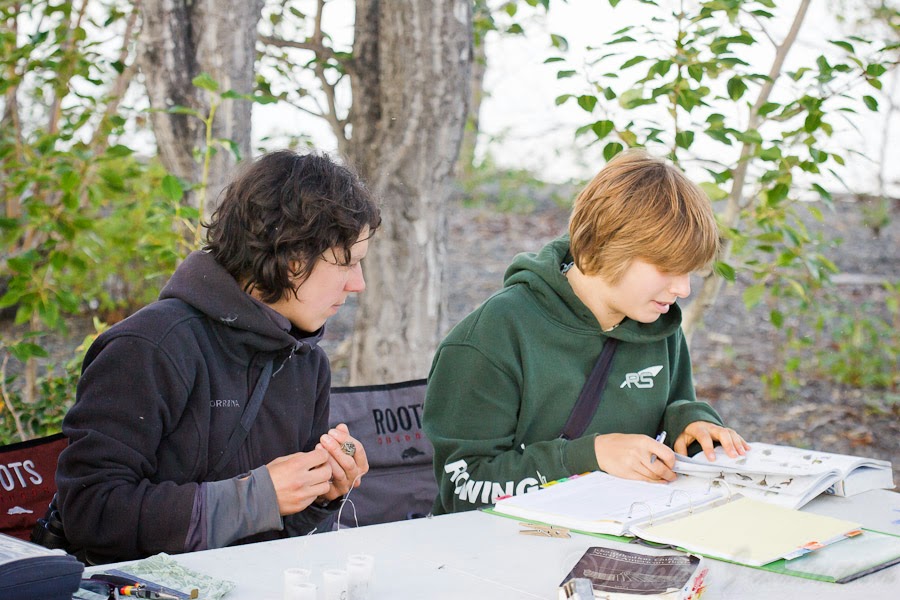
Volunteers Sarah Nägl (L) and Ariel Lenske (R) trying to figure out what the heck is this bird? Answer, a juvenile Common Redpoll without red poll.

Welcome to the first blog entry of TLBO's 2014 fall season. First we want to apologize for the lack of blog entries but we've had certain difficulties like no internet.

The season was opened a couple of days late due to other commitments of all the staff members. The lake water was and has been relatively high so that the sandbars at the mouth of Ten Mile Creek have just recently become visible and bad weather has hindered the operation more than on any other year. We've already lost six full mornings and parts of many other to rain and wind! On the plus side we've had two great long term volunteers - Ariel Lenske of Cowichan Bay, BC, spent three weeks with us and Sarah Nägl of Berlin, Germany, is still holding on and seems determined to stay into October!

A juvenile Brown-headed Cowbird - only the 2nd ever banded at TLBO

A juvenile Golden-crowned Sparrow
It has also been a very slow start for the season. The missed netting hours of course effect the number of birds banded but even when the weather did cooperate the going was slow early in the season. The migration finally picked up on Aug 20 and since then we've had many mornings around and over 100 birds banded including 224 banded on Aug 23. In spite of the good numbers lately the total is still less than on this date on the previous poorest year! As expected Alder Flycatcher (434) leads the way followed by Yellow Warbler (297), Pine Siskin (211), Yellow-rumped (121) and Wilson's Warbler (88). Pine Siskin has been the surprise species of the season as the current total is already twice the previous season high and siskin flocks continue to roam the area. The most interesting captures have been the observatory's 2nd and 3rd banded Brown-headed Cowbirds on Aug 7 and a Golden-crowned Sparrow, the 2nd ever banded in fall, on Aug 21. This season we've also put in some regular, weekly, effort in owl banding. Besides just playing a playback at the regular netting area we also set a site in some conifers higher up on the slope and away from the lake. This has so far resulted banding of eight Boreal Owls.

Pine Siskin - the current headline maker!

Our volunteers and the pile of used bird bags after 224 birds were banded on Aug 23
Wilson's Snipe is almost all bill!

 No actual rarities have been seen so far and visible migration has been very slow too. A nearly complete lack of migrating raptors and Thayer's Gulls is baffling. On Aug 27 over 3300 Greater White-fronted Geese were counted flying by the observatory as well as a lone Swainson's Hawk. Another one passed by the previous day. In the last couple of weeks species like Parasitic Jaeger and Red-throated Loon have become a regular sight on the lake and on the land species like Rusty Blackbird, American Pipit and Townsend's Solitaire have clearly started their fall movement too. A Sanderling touched down briefly on Aug  23, and there has been higher number of Red-necked Phalaropes seen than the average. Four sighted Black-backed Woodpeckers is a higher count than usual. Meanwhile we've seen only two Three-toed Woodpeckers and White-winged Crossbills have mysteriously almost disappeared after a summer of abundance.

A Merlin flying right over the banding table
This Northern Pintail has been living in the pond for a couple of weeks now!
The most exciting and rare sighting of the year has not been a bird but this leucistic Porcupine. Looks like a tiny spiny Polar Bear, doesn't it?

Here are the banding totals as of Aug 31 (including birds banded as part of the owling effort):

Sharp-shinned Hawk - 3
Solitary Sandpiper - 1
Wilson's Snipe - 1
Boreal Owl - 8
Belted Kingfisher - 7
Yellow-bellied Flycatcher - 3
Alder Flycatcher - 434
Least Flycatcher - 2
Hammond's Flycatcher - 4
Dusky Flycatcher - 3
Warbling Vireo - 12
Black-capped Chickadee - 13
Boreal Chickadee - 2
Red-breasted Nuthatch - 2
Ruby-crowned Kinglet - 14
Swainson's Thrush - 41
American Robin - 9
Varied Thrush - 1
Orange-crowned Warbler - 27
Yellow Warbler - 297
Yellow-rumped Warbler - 121
Townsend's Warbler - 9
Blackpoll Warbler - 55
American Redstart - 25
Northern Waterthrush - 40
Common Yellowthroat - 39
Wilson's Warbler - 88
American Tree Sparrow - 2
Chipping Sparrow - 14
Savannah Sparrow - 11
Fox Sparrow - 2
Lincoln's Sparrow - 6
White-crowned Sparrow - 7
Golden-crowned Sparrow - 1
Slate-coloured Junco - 46
Rusty Blackbird - 1
Brown-headed Cowbird - 2
Purple Finch - 3
White-winged Crossbill - 2
Common Redpoll - 1
Pine Siskin - 211

Total = 1570 birds of 41 species

Sunday, May 4, 2014

Albert Creek Bird Observatory Spring 2014 - April 23 to May 4

Once again this year we were challenged by the weather. The first week was spent setting up the station with two feet of snow still on the ground. The first few days brought few birds and plenty of snow. Most of our observations consisted of the “winter finch” and other “nomadics” category such as White-winged Crossbills, Common Redpolls, Pine Siskin and Bohemian Waxwing. Ruby-crowned Kinglets were evident and the local population of Boreal and Black-capped Chickadees were very busy. There were at least two pairs of Trumpeter Swans working the marsh and oxe bow area and possibly three. Ducks were few and far between as things remained ice bound. Tundra Swan and Greater white-fronted Goose have been low in numbers as they are expected at this time period. The familiar “big push of sparrows” is yet to happen as we have had dribs and drabs of Slate-colored Junco, American Tree Sparrow and Gambel’s White-crowned Sparrow. Fox Sparrows have been scarce. The first Myrtle Warbler was only detected on May 3rd. Species detected, slowly increased in week two bringing such familiar songsters as Varied Thrush. The first Hermit Thrush was detected on April 28th as it was banded while the first Rusty Blackbird was observed. Albert Creek’s star bird is still cooking for someone. The Barred Owl has been heard daily. As of May 4th the Rusty Blackbird crowd increased to 12 with a pair being banded.

Weather changed in the second week bringing frozen nights but bright blue skies during the day. The roblem was north winds prevailed with a brief change on May 3rd when south winds prevailed. It has been a late spring so far for species and numbers of species.

Thank you to our volunteers Susan Drury and Maxime Beauchamps for their help this past week, particularly with the arduous task of setting of the station.

Birds banded from April 23rd – May 4th

Black-capped Chickadee – 1
Boreal Chickadee – 11
Ruby-crowned Kinglet – 20
Hermit Thrush -1
Varied Thrush – 1
Myrtle Warbler – 1
American Tree Sparrow – 12
White-crowned Sparrow -2
Slate-colored Junco – 11
Rusty Blackbird – 2
Common Redpoll – 4


Total = 66 birds of 11 species

Monday, November 4, 2013

Teslin Lake - end of the season 2013

Warmer than average fall was evident in just small amount of snow on the surrounding mountains and none on the lake level!
 
And so yet another season at TLBO came to an end. There is not much to be written about the last two weeks mostly because yours truly spent a significant portion of it in bed, sick. After mid-month there were still good numbers of Bohemian Waxwings around and a few gulls were patrolling the lake. The last day, Oct 31, a family of Trumpeter Swans was seen as well as a juvenile Common Loon. Of course, the local family of Gray Jays and the usual Black-billed Magpies and Common Ravens were around and about. Small number of Common Redpolls were on the move and one flock had a Pine Siskin in the tow. One Golden Eagle was seen heading south as well.

I can boogie!

Youngsters Thayer's (front) and Herring Gull

A family of Trumpeter Swans on the cold foggy lake
 
Below are the season's raptor counts, species organized in the order of abundance. Notice that these numbers include both the birds observed flying by the observatory in migration flight as well as birds just hanging around. Bald Eagle gets the biggest gain from this as there were a few local birds present throughout the season.

Sharp-shinned Hawk       849
Red-tailed Hawk               447
Northern Harrier              299
Golden Eagle                     293
American Kestrel              178
Bald Eagle                          160
Rough-legged Hawk         126
Merlin                                   76
Osprey                                  72
Peregrine Falcon                 51
Northern Goshawk             18
Swainson's Hawk                  3
= 2572 raptors identified to species (+ 100+ unidentified ones)


Sharp-shinned Hawk was the most common raptor this season. Photo from August.
 
Finally, I'd like to thank a few people for making the season successful. First and foremost all of our financial supporters - without you there wouldn't be anyone doing anything at TLBO! The long term volunteers Abril Heredia and Sarah Coulthart put in a lot of time, day after day, and made things go so much smoother. Doug Martens provided the BIC with a comfortable accommodation once again and Ted Murphy-Kelly provided the volunteers with a cozy tent accommodation at the site and all the things one needs for day to day life in the outdoors. Shyloh van Delft for organizing a fund-raiser in Tagish in August. The Schonewille's for storing gear and Ben S and Nick Guenette for the set-up at the start of the season. And of course, all the other volunteers and visitors - the list is too long to mention everyone by name. THANK YOU everyone!


Parting shot - a grouse was here!

Thursday, October 17, 2013

Teslin Lake update - October 15


The nights are getting colder and the lake foggier
There was still a good number of passerines around early October as there were kinglets, chickadees, sparrows and even some warblers flitting in the bushes of TLBO. Unfortunately the banding season came to an unexpected halt after Oct 2nd when the promised help didn't show up. A few nets were opened every once in a while for short periods of time when visible migration was very slow and the very last banding effort was made on Oct 11 when Ted Murphy-Kelly came to help out with taking down the station. That and the following day we managed to pack the tents and all the netting related gear except for the canopy net structure. As for the birds banded, 104 more birds received some jewellery in October. Perhaps the most exciting ones were the two Northern Waterthrushes (Oct 1st and Oct 3rd, one of them staying until the 5th!) as they were the first October records for TLBO. The species is normally quite uncommon already in early September! The season 2nd Gray-cheeked and Hermit Thrushes were banded on the 2nd. The final season top five is as follows - Alder Flycatcher 770, Dark-eyed Junco 341, Yellow Warbler 333, Yellow-rumped Warbler 163 and Ruby-crowned Kinglet 125. Overall it was the second poorest year (of the full operation years) in terms of number of birds banded at TLBO. Five species were banded in record low numbers - Sharp-shinned Hawk, Hermit Thrush, Wilson's Warbler, White-crowned Sparrow and Common Redpoll. Three species were banded in record high numbers - Northern Flicker, Warbling Vireo and Cedar Waxwing. Other species with higher than average numbers included Yellow-bellied and Alder Flycatcher, Swainson's Thrush and Dark-eyed Junco.
 

A young Northern Waterthrush banded on Oct 1st
 
Adult male Rusty Blackbird - very exciting as we normally get just youngsters
 
A happy bander (Ted Murphy-Kelly) with the last two birds of the season - a Boreal Chickadee staying here and a Wilson's Warbler on it's way to UNAM Jardin Botanico en Ciudad de Mexico (or somewhere thereabouts)!
 
Early to mid-October is normally one of the busiest and most exciting times at TLBO with visible migration and rarities. However, this year no rarities were spotted and the migration for the most part was pretty disappointing. The last big day of "dickie bird" migration was Oct 1st when nearly 1500 American Robins were counted alongside 1300 other passerines including 90 Yellow-rumped Warblers, 270 Pine Siskins and an observatory record of 296 Rusty Blackbirds! 69 Rusties on the 7th was the last high count for that species. 215 Bohemian Waxwings flew by on the 4th and about 100 roamed the area on the 15th. Usually the big thing at this time of the year are the thousands of swans passing by. This year no such thing has been seen. So far the busiest swan day was the 10th when about 800, mostly Tundra Swans,  were counted. 215 Trumpeter Swans were seen the next day and another 150 were tallied on the 15th. Other waterfowl of interest during the period included a late flight of 112 Lesser Scaup and a lone late Snow Goose on the 10th and three Harlequin Ducks on the 11th. October is typically the time of eagles as well. This year there have been very few Bald Eagles seen, perhaps because many left earlier, but it has been quite good with Golden Eagles. The highest day counts so far have been 31 on the 4th, 37 on the 5th and observatory record 86 on the stormy day of the 9th. Finally, birds behind the usual departure dates included a Bonaparte's Gull on the 5th and a Wilson's Warbler on the 12th.


This flock of 47 Trumpeter Swans is an exception to the rule that only Tundra Swans fly high and in big flocks

A Bohemian Waxwing enjoying Highbush Cranberries

A rather late juvenile Mew Gull on the 11th

This Orange-crowned Warbler in a Cottonwood probably wishes it was already in a Magnolia-tree instead!

Ruffed Grouse have just recently started their fall drumming season
 
Omega-3s for an Otter
 
Chris Sukha: "ahh yes, I confirm, it is a speck!" Photo Abril Heredia.
 
Rude Boy - the observatory punk-dogger

  This season's longest serving volunteer, Sarah Coulthart, left us on the 2nd. Thank you Sarah for all your help and we applaud your endurance as you now hold the observatory record for most consecutive days spent in a tent at the site! The same day saw another volunteer, a published author Chris Sukha (The Mini-Mentor Guide To Birdwatching for Beginners) leave as well. Chris had spent a full season at Mackenzie Nature Observatory in BC and after Mackenzie season ended he came and helped us out for a week. Thanks Chris for spotting all the specks in the sky!

 
Banding totals, end of banding season (the # banded since the last update in brackets):
 
Sharp-shinned Hawk - 6
Solitary Sandpiper - 2
Spotted Sandpiper - 1
Belted Kingfisher - 2
Yellow-bellied Sapsucker - 1
American Three-toed Woodpecker - 1
Northern Flicker - 3
Western Wood-Pewee - 4
Yellow-bellied Flycatcher - 11
Alder Flycatcher - 770
Least Flycatcher - 6
Hammond's Flycatcher - 12
Dusky Flycatcher - 3
Northern Shrike - 1
Warbling Vireo - 48
Black-capped Chickadee -31
Boreal Chickadee - 23 (10)
Red-breasted Nuthatch -6
Golden-crowned Kinglet - 1
Ruby-crowned Kinglet - 125 (18)
Gray-cheeked Thrush - 2 (1)
Swainson's Thrush - 55
Hermit Thrush - 2 (1)
American Robin - 4
Varied Thrush - 5
American Pipit - 2
Cedar Waxwing - 8
Tennessee Warbler - 1
Orange-crowned Warbler - 124 (9)
Yellow Warbler - 333 (3)
Magnolia Warbler - 1
Yellow-rumped Warbler - 163 (13)
Townsend's Warbler - 7
Blackpoll Warbler - 87
American Redstart - 33
Northern Waterthrush - 46 (2)
MacGillivray's Warbler - 1
Common Yellowthroat - 64
Wilson's Warbler - 122 (7)
American Tree Sparrow - 19 (11)
Chipping Sparrow - 20
Savannah Sparrow - 18
Fox Sparrow - 7 (1)
Lincoln's Sparrow - 9
White-crowned Sparrow - 16
Golden-crowned Sparrow - 1
Dark-eyed Junco - 341 (20)
Rusty Blackbird - 14 (6)
Purple Finch - 1
White-winged Crossbill - 5 (2)
Pine Siskin - 8
= 2577 (104) birds, 51 species