Tuesday, September 15, 2015

Teslin Lake update - Sept 15, 2015 - Blackburnian Warbler!


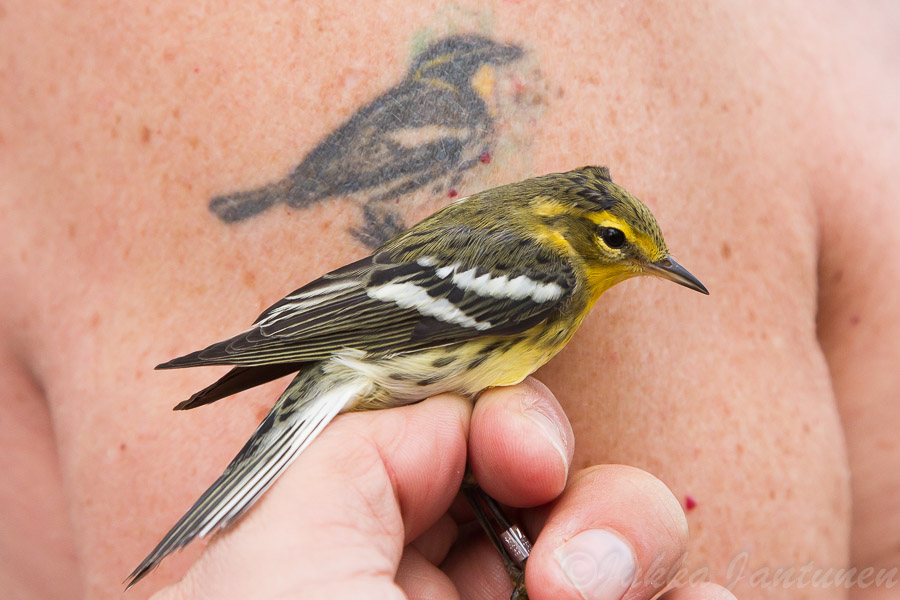
Blackburnian Warbler - the first record for the Yukon
Today it happened, the bird we've always waited for, Ted's favorite bird, a Blackburnian Warbler found our nets on the 11:45am net check!! Hélène was the lucky one to extract it from a net and yours truly was given the honors to put a band on it. It was determined to be a young male, age confirmed by incomplete skull ossification.


This is the first record for the Yukon! It's range extends to the Peace country of BC where it is quite rare a bird around Fort St John - Chetwynd - Dawson Creek as far as I know. That is about 1000km southeast from Teslin. The core range is from Alberta/Saskatchewan east. You can learn more about Blackburnian Warbler from  http://www.allaboutbirds.org/guide/Blackburnian_Warbler/id

Here our star alongside Ted's tattoo of an adult male of the same species, his favorite bird!
For the full suite of photos of our bird please visit https://www.flickr.com/photos/jukka_jantunen/

As you all may know, one has to be careful what one wishes for and likewise be very careful what one promises. It so happened that I went and promised early season that if we were to catch a Blackburnian Warbler I'd jump into the lake - and so I had to. Luckily Ted and Hélène were brave and kind enough to join me.

Ted (L), Jukka (M) & Hélène (R) in the really really ridiculously cold Teslin Lake! Photo actually by Francis Bordeleau-Martin.

Jukka,
the Bander-in-charge

Friday, September 11, 2015

Teslin Lake update - September 10, 2015

An adult Bald Eagle watches the world from atop of a spruce tree

The weather was very unsettled early in the period with rain and cold north winds. The surrounding mountains got lots of snow which did mostly melt away. The rain combined from this and the last period was enough to bring the lake up to about the same it was at the start of the season and our pond actually has a lot more water now than at the start - something we've never seen before! Towards the end of the period we had some nicer weather, even some sun, and the owling crew was fortunate to enjoy an amazing display of northern lights on the night of Sept 8th/9th.

Fresh snow blanketed the surrounding mountains, even the lower ones!
Banding remained very busy and, even though we lost one complete and most of three other mornings to weather, we banded a total of 1023 birds. Those lost days were compensated by high numbers on days when we were able to operate, including 201 banded on the 4th and 231 on the 7th. Four new species were added for the season: Golden-crowned Kinglet on the 5th, American Tree Sparrow on the 3rd, Golden-crowned Sparrow on the 7th and Rusty Blackbird on the 3rd. 29 American Tree Sparrows banded on the 7th was an unprecedented influx this early in the season. The period top five was Yellow Warbler 218, Orange-crowned Warbler 142, Wilson's Warbler 126, Yellow-rumped Warbler 105, and Alder Flycatcher 97. The current season top five is Alder Flycatcher 1050, Yellow Warbler 511, Wilson's Warbler 304, Yellow-rumped Warbler 242, and Orange-crowned Warbler 241. The current season total is the highest for the date in the observatory's history. During the period five species (Alder Flycatcher, American Pipit, Yellow Warbler, Wilson's Warbler and Savannah Sparrow) reached a new season record. Of course, the most remarkable of these is the now over 1000 Alder Flycatchers!!

Alder Flycatcher #1028!!
The season 1st Golden-crowned Kinglet was a scruffy-looking young male

 No real rarities were seen or banded but the first two days of September were great migration days. On the 1st 761 raptors were counted for a new observatory one day record. 588 of those were Red-tailed Hawks including one of subspecies abieticola, the 1st positive ID of the taxon for the observatory, and one nearly completely white leucistic one! Other raptors on the move that day included the season 1st Golden Eagle, Northern Harrier 87, Swainson's Hawk 32 and Peregrine Falcon 12. On the 2nd, further 367 raptors were seen including Red-tailed Hawk 204, Northern Harrier 64, Sharp-shinned Hawk 50, Swainson's Hawk 4, and American Kestrel 37. The Swainson's Hawk season total is now over 100 - more than four times the previous highest season total!! 

This almost all white Red-tailed Hawk was a most unusual sight!

A juvenile female Northern Harrier

During the cold and wet weather many migrants were foraging along the shore just like this young Say's Phoebe

Other birds heading south on those days included 906 Sandhill Cranes on the 1st and 859 on the 2nd, and 70 Rusty Blackbirds on the 1st and 53 on the 2nd. These numbers are unusually high for both species at this time of the year. Unusual sightings included two somewhat late juvenile Arctic Terns, an American Golden Plover, and an Upland Sandpiper on the 1st, and the season 1st Glaucous Gull and a Baird's Sandpiper on the 2nd. Later on the pace quieted significantly and no high counts of anything were made but naturally the odd interesting sighting was made. On the 3rd a late Cliff Swallow was seen flying south and the season first group of Golden-crowned Kinglets foraged in a spruce top visible from the banding spot. The season 1st Three-toed Woodpecker was seen on the 7th and a Sanderling, possibly the same juvenile, was seen both on the 7th and on the 9th. 

Baird's Sandpipers are not often seen on our rocky shoreline even if it is a common migrant on mudfalts
The second year Common Loons like this one are not often seen in the northern interior. Most of them spent the first two years of their lives on the wintering grounds.
Not all the exciting things with wings are birds. Here a female Zigzag Darner.


The banding totals as of Sept 10 (the number in brackets indicates the number banded since the previous blog entry):
Sharp-shinned Hawk - 11 (2)
Solitary Sandpiper - 3
Belted Kingfisher - 6
Downy Woodpecker - 1 (1)
Olive-sided Flycatcher -2
Western Wood-Pewee - 4 (2)
Yellow-bellied Flycatcher - 11
Alder Flycatcher - 1050 (97)
Least Flycatcher - 4
Hammond's Flycatcher -16 (6)
Dusky Flycatcher - 2 (1)
Say's Phoebe - 2
Warbling Vireo - 8 (1)
Gray Jay - 1
Common Raven - 1
Black-capped Chickadee -27 (3)
Boreal Chickadee - 49 (41)
Red-breasted Nuthatch - 8
Golden-crowned Kinglet - 1 (1)
Ruby-crowned Kinglet - 87 (56)
Gray-cheeked Thrush - 6 (4)
Swainson's Thrush - 66 (7)
Hermit Thrush - 4 (2)
American Robin - 3 (1)
American Pipit - 5 (4)
Tennessee Warbler -7 (1)
Orange-crowned Warbler - 241 (142)
Yellow Warbler - 511 (218)
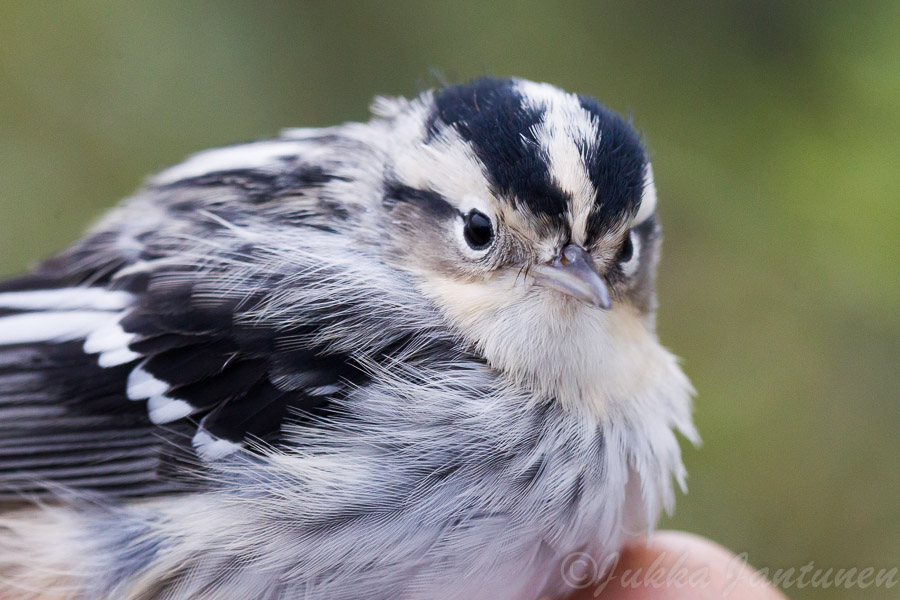
Black-and-white Warbler - 1
Yellow-rumped Warbler - 242 (105)
Townsend's Warbler - 2
Blackpoll Warbler - 98 (28)
American Redstart - 33 (6)
Northern Waterthrush - 52 (7)
Common Yellowthroat - 67 (32)
Wilson's Warbler - 304 (126)
American Tree Sparrow - 40 (40)
Chipping Sparrow - 28 (3)
Savannah Sparrow - 35 (14)
Fox Sparrow - 21 (15)
Lincoln's Sparrow - 27 (6)
White-crowned Sparrow - 11 (2)
Dark-eyed Junco - 68 (40)
Rusty Blackbird - 7 (7)
Brown-headed Cowbird - 1
Common Redpoll - 5 (4)

= 3180 (1023) birds of 47 (4) species

Sunday, September 6, 2015

Teslin Lake update - August 31, 2015

Fresh snow on the surrounding mountains on the morning of Aug 30th

For the last ten days of August the weather remained very unsettled. Fortunately we only lost two full mornings of banding as for the most part the pattern remained the same - cloudy with showers in the morning and solid rain in the afternoon. It rained so much that the lake started to come up again. As much as it is the human nature to complain about the weather, the weather we had actually brought us some great birding and good numbers. As the fresh snow blanketed all of the alpine and lot of the treeline as well in the last few days of the month it first dropped many of the passerines living up there down and then, together with northwest winds, created an unprecedented exodus of Swainson's Hawks among other birds fleeting the suddenly early October like conditions.

This Ruby-crowned Kinglet was the 2000th bird banded this season

 Of the eight mornings we were able to operate on six we banded over a hundred birds. In total, we banded 939 birds and the top five was as follows: Alder Flycatcher 405, Yellow Warbler 137, Wilson's Warbler 77, Orange-crowned Warbler 68, and Yellow-rumped Warbler 58. Some of the more interesting birds banded included the season 2nd Olive-sided Flycatcher on the 27th, also the season 2nd Say's Phoebe on the 26th, the season first Gray-cheeked Thrush on the 23rd, two fairly late Tennessee Warblers, one on the 27th and the other on the 31st, the season first American Tree Sparrow on the 26th, and finally, a late Warbling Vireo and the season first Common Redpoll on the 31st. 

Adult (L) and hatch-year (R) Lincoln's Sparrow showing the color difference of the face and particularly rear eye-brow - pure gray on adult but with greenish tint on the HY

While the banding was very busy throughout the period the more interesting sightings and high visible migration counts took place late, between the 25th and the end of the month. The first wave of Greater White-fronted Geese was seen on the 25th when 1700 were tallied but the big movement went through in a few early afternoon hours of the 28th. That day's count 6850 is the observatory's 2nd highest. That day was also the first one with some notable raptor movement as 174 were counted including Northern Harrier 69, Sharp-shinned Hawk 34, Red-tailed Hawk 29, American Kestrel 27, Swainson's Hawk 9 and Peregrine Falcon 4. 390 Sandhill Cranes was also a very good count this early in the season and the seven Say's Phoebes seen during the morning set a new day record. The 29th was a day of heavy rain and no bird movement but on the 30th the wind started to blow from northwest again bringing a modest flight of 500 Greater White-fronted Geese, likely the last decent flight of the species this fall, and a tally of 146 raptors including Sharp-shinned Hawk 46, Red-tailed Hawk 40, Northern Harrier 27, Swainson's Hawk 10 and Peregrine Falcon 10. The 31st belonged to Swainson's Hawk as the day total of 52 far exceeded anything we had ever seen before and was about twice as many as the highest previous season total!! Other notable raptor counts for the day included Northern Harrier 64, Red-tailed Hawk 25, and Sharp-shinned Hawk 21. 

One of the many small flocks of Sandhill Cranes seen during the last few days of August

Due to rainy conditions many raptors flew very low and some like this American Kestrel even stopped briefly at the tip

While the Swainson's Hawk flight was the phenomenon of the period the two most exciting birds were both real big time rarities. A Black-and-white Warbler was first seen from the campground cooking shelter on the afternoon of the 29th and then caught and banded on the 30th. It was the first record for the observatory and for the whole Teslin area. Even more rare was an unidentified Chaetura swift (Chimney/Vaux's) seen briefly on the 28th. It was the first record for the Yukon!

The Black-and-white Warbler by the cooking shelter. Photo by Hélène Dion-Phenix and Francis Bordeleau-Martin

And presumably the same bird when caught and banded on the 30th


This Chaetura Swift was the first record for the Yukon

The sightings of other less common species during the period included two Sanderlings on the 24th, a Common Nighthawk flew over the campfire in the evening of the 26th and two were seen early the next morning, two American Golden-Plovers flew by on the 28th, a Townsend's Warbler was seen on both the 28th and the 29th, and a Baird's Sandpiper was seen on the 30th.

Bonaparte's Gulls are already uncommon in late August and birds in full juvenal plumage are really quite rare at that late a date

The season's first Downy Woodpecker stopped at the tip briefly on the 24th

The banding totals as of Aug 31 (the number in brackets indicates the number banded since the previous blog entry):

Sharp-shinned Hawk - 9 (3)
Solitary Sandpiper - 3
Belted Kingfisher - 6 (2)
Olive-sided Flycatcher -2 (1)
Western Wood-Pewee - 2
Yellow-bellied Flycatcher - 11 (3)
Alder Flycatcher - 953 (405)
Least Flycatcher - 4 (1)
Hammond's Flycatcher -10 (6)
Dusky Flycatcher - 1 (1)
Say's Phoebe - 2 (1)
Warbling Vireo - 7 (2)
Gray Jay - 1 (1)
Common Raven - 1
Black-capped Chickadee -24 (12)
Boreal Chickadee - 8 (8)
Red-breasted Nuthatch - 8 (2)
Ruby-crowned Kinglet - 31 (11)
Gray-cheeked Thrush - 2 (2)
Swainson's Thrush - 59 (31)
Hermit Thrush - 2 (1)
American Robin - 2
American Pipit - 1
Tennessee Warbler - 6 (2)
Orange-crowned Warbler - 99 (68)
Yellow Warbler - 293 (137)
Black-and-white Warbler - 1 (1)
Yellow-rumped Warbler - 137 (58)
Townsend's Warbler - 2
Blackpoll Warbler - 70 (21)
American Redstart - 27 (8)
Northern Waterthrush - 45 (11)
Common Yellowthroat - 35 (26)
Wilson's Warbler - 178 (77)
Chipping Sparrow - 25
Savannah Sparrow - 21 (7)
Fox Sparrow - 6 (5)
Lincoln's Sparrow - 21 (10)
White-crowned Sparrow - 9 (9)
Dark-eyed Junco - 28 (28)
Brown-headed Cowbird - 1
Common Redpoll - 1 (1)

= 2157 (939) birds of 43 (7) species

Thursday, August 20, 2015

Teslin Lake update - August 20, 2015


A fleet of Common Loons off the point

Teslin Lake Bird Observatory opened the 2015 fall season on Jul 26. Unlike last year there was plenty of exposed shoreline already at the start due to low snow pack last winter and a fairly dry summer. Unfortunately the dryness has since come to an end and in the last three weeks  we've had exactly one day when it didn't rain at all. Luckily most of the rain has come in the afternoons and we haven't lost very much of operation time. However, it has been tough for our volunteers as they've often been confined to indoors or their tents after the work due to some pretty heavy rain. This year we have two volunteers, Hélène Dion-Phenix and Francis Bordeleau-Martin, from Quebec for the whole season. Allyn Esau from Edmonton, Alberta, has been with us almost from the start, Gwen Baluss from Juneau, Alaska, did her usual and much appreciated four day stint last week, and quite a number of other volunteers have been helping out particularly on the weekends.

Hélène Dion-Phenix banding a Ruby-crowned Kinglet

This young male Yellow-rumped Warbler was the 1000th bird banded this fall season

 The banding has been quite good and steady, and the season total 1218 is the second highest for the date in the observatory's history. The current top 5 is as follows: Alder Flycatcher 548, Yellow Warbler 156, Wilson's Warbler 101, Yellow-rumped Warbler 79, and Blackpoll Warbler 49. Some of the banding highlights have included an Olive-sided Flycatcher on Jul 27 (only the 2nd for fall banding), a Say's Phoebe on Aug 14 (the 1st since 2010), a Common Raven on Aug 18 (the 3rd ever), and an American Pipit on Aug 13.

This Olive-sided Flycatcher was only the 2nd ever banded in fall at TLBO

Say's Phoebe is a fairly common migrant through the site but not often banded. The previous one was in 2010.

Male (L) and female (R) Red-breasted Nuthatch

So far we've had two sightings of rare birds this fall. The observatory's 2nd and the Yukon's 5th record of Black Turnstone, a juvenile, was seen on the south beach on Aug 12 and the observatory's 1st record of Short-billed Dowitcher, also a juvenile, spent Aug 16 to 18 in the pond giving great views to everyone.

This juvenile Black Turnstone was only about the 5th record for the Yukon
Juvenile Short-billed Dowitcher photographed on the first morning (Aug 16) of its three day stay

The visual migration counts have revealed very little movement of bigger birds. There have been several flocks of Greater White-fronted Geese, the first ones very early in August and definitely ahead of the expected schedule, and one flock of nine Sandhill Cranes on Aug 13, also very early. Very few raptors have been on the move but an adult male Peregrine Falcon on Aug 15 put up quite a show and in the end captured an Arctic Tern. Other observations of interest have been daily Red-throated Loons and local Merlins, the first few Thayer's Gulls in mid-August, early sightings of Northern Shrike on Aug 6 and Black-backed Woodpecker on Aug 17, and a few small groups of Boreal Chickadees in the past week perhaps indicating a beginning of movement.

A female Red-breasted Merganser with her little ones

A Blackpoll Warbler still partially in juvenile plumage

Of the non-feathered friends of ours There must be more than ten Red Squirrels in the area and a few Least Chipmunks are chucking away on most mornings.  Porcupines have been present almost daily providing us with endless entertainment. A Black-tailed Weasel, or Ermine (your pick), has visited the banding table area a few times. Luckily it hasn't caused any issues at the nets.

Yummy!

So cute, so deadly

The banding totals as of Aug 20:

Sharp-shinned Hawk - 6
Solitary Sandpiper - 3
Belted Kingfisher - 4
Olive-sided Flycatcher - 1
Western Wood-Pewee - 2
Yellow-bellied Flycatcher - 8
Alder Flycatcher - 548
Least Flycatcher - 3
Hammond's Flycatcher - 4
Say's Phoebe - 1
Warbling Vireo - 5
Common Raven - 1
Black-capped Chickadee - 12
Red-breasted Nuthatch - 6
Ruby-crowned Kinglet - 20
Swainson's Thrush - 28
Hermit Thrush - 1
American Robin - 2
American Pipit - 1
Tennessee Warbler - 4
Orange-crowned Warbler - 31
Yellow Warbler - 156
Yellow-rumped Warbler - 79
Townsend's Warbler - 2
Blackpoll Warbler - 49
American Redstart - 19
Northern Waterthrush - 34
Common Yellowthroat - 19
Wilson's Warbler - 101
Chipping Sparrow - 25
Savannah Sparrow - 14
Fox Sparrow - 1
Lincoln's Sparrow - 11
Brown-headed Cowbird - 1

= 1218 birds of 36 species